Botox or Dysport?
Let’s be honest — the moment most people start researching neurotoxin treatments, they hit a wall of confusing information fast. Botox. Dysport. Units. Dosing. Crow’s feet. Preventative treatment. It can feel overwhelming before you’ve even booked a consultation. And the last thing you want is to walk into a clinic feeling like you have no idea what you’re agreeing to.
Here’s the good news: the core concept behind neurotoxin treatments is actually straightforward, the differences between Botox and Dysport are manageable once someone explains them clearly, and the decision about which one is right for you doesn’t have to be stressful — especially when you have a physician walking you through it.
This guide is designed to give you everything you need to understand neurotoxins, make an informed decision, and feel genuinely confident going into your first — or next — appointment. Let’s start at the beginning.
Botox or Dysport in San Antonio? A Physician’s Guide to Choosing the Right Neurotoxin
1. What Is a Neurotoxin, Really?
The word “neurotoxin” sounds alarming at first glance. Toxic? That doesn’t sound like something you’d voluntarily have injected into your face. But context matters enormously here, and once you understand the mechanism, the name becomes a lot less scary.
A neurotoxin, in the context of aesthetic medicine, refers to a purified, highly diluted form of botulinum toxin type A — a protein derived from the bacterium Clostridium botulinum. In its raw, concentrated form, botulinum toxin is indeed powerful. But the amounts used in cosmetic treatment are so tiny, so precisely calibrated, and so localized that the word “toxic” really doesn’t capture the clinical reality of the experience.
Think of it this way: water is essential for life, but too much of it can be dangerous. The dose and the context define the effect. In cosmetic neurotoxin treatments, the dose is measured in units so small they’re invisible to the naked eye, and the effect is entirely local — contained to the specific muscle being treated.
Both Botox and Dysport are FDA-approved neurotoxin products. Both have decades of clinical use behind them — not just in aesthetics, but in medical applications including migraine treatment, hyperhidrosis (excessive sweating), muscle spasticity, and more. These are among the most studied injectable products in modern medicine.
2. How Neurotoxin Injections Actually Work
Here’s where things get genuinely interesting, because the mechanism of action is elegant in its simplicity.
Your facial expressions are created by muscles contracting beneath the skin. When you squint at bright light, furrow your brow in concentration, or smile so wide your eyes crinkle — those are all muscle contractions happening just below the surface. Over years of repeated movement, those contractions create creases in the overlying skin. At first those creases appear only when you’re making the expression. Eventually, with enough repetition, they become static — present even when your face is at rest.
Neurotoxin injections work by temporarily blocking the signal between the nerve and the muscle, preventing the targeted muscle from contracting with its full force. The nerve signal still travels — the neurotoxin doesn’t affect nerves themselves — but the chemical messenger (acetylcholine) that tells the muscle to contract is temporarily blocked at the junction point.
The result? The treated muscle relaxes. The overlying skin smooths. Lines soften or disappear. And because the muscle isn’t contracting repeatedly, the existing creases get a chance to improve over time — and new ones are prevented from forming.
This is why neurotoxin treatment is as much a preventative strategy as a corrective one. You’re not just treating lines that already exist. You’re interrupting the very process that creates them.
3. Botox and Dysport: More Alike Than Different
Before we get into the differences, it’s worth establishing the common ground — because Botox and Dysport share far more than they differ.
Both products contain botulinum toxin type A. They work through the exact same mechanism of action described above. Both are FDA-approved for cosmetic use in adults. Both are administered via injection by a trained provider. Both produce temporary results. Both have strong, long-standing safety profiles backed by extensive clinical use.
If you’ve heard strong opinions about one being “better” than the other, know that this is largely a matter of individual anatomy, provider preference, and specific treatment goals — not a universal clinical verdict. Many experienced providers, including physician-led practices like 79Aura, keep both products available precisely because different situations call for different tools.
The most important factor in your neurotoxin outcome is not which brand is in the syringe. It is the skill, judgment, and anatomical knowledge of the person holding it.
4. The Real Differences Between Botox and Dysport
With that context established, let’s look at what actually distinguishes these two products — because the differences are real and clinically relevant, even if they’re more nuanced than the marketing around each product suggests.
Formulation and molecular structure. Botox and Dysport use the same active ingredient, but they are formulated differently. Dysport uses a slightly smaller protein complex, and the accompanying proteins differ between the two products. This affects how each product behaves once injected.
Diffusion — how far the product spreads. This is one of the most practically significant differences. Dysport has a tendency to diffuse — spread — slightly more from the injection site than Botox. In the right treatment area, this can actually be an advantage: for larger muscle groups like the forehead, broader diffusion can mean a more even, natural result with fewer injection points. In areas requiring very precise, localized treatment, a product with less diffusion may be preferred.
Unit equivalence. Botox and Dysport are not dosed on a 1:1 unit basis. Dysport units are smaller, so more units are needed to achieve an equivalent effect. This is a frequent source of confusion for patients comparing prices across clinics. The relevant comparison is always the total treatment outcome, not the unit count. A provider who quotes you “more units” of Dysport is not necessarily giving you more product — they may simply be describing the same amount of effect in a different unit denomination.
Onset time. Many providers and patients report that Dysport tends to show results slightly faster than Botox — sometimes within two to three days, compared to three to five days for Botox. This difference is modest and may not be clinically significant for most clients, but it’s worth knowing if you have a specific event on your calendar.
Duration. Both products are temporary, with results typically lasting three to four months. Some individuals metabolize neurotoxins faster than others, and results may vary accordingly. Regular maintenance treatments help sustain and improve outcomes over time.
5. Which Neurotoxin Is Right for You?
So how do you actually decide? The honest answer is: you probably shouldn’t decide alone — and you don’t have to.
At a physician-led practice, the product selection is part of the clinical assessment. Your provider will evaluate your facial anatomy, the specific areas you want treated, your treatment history, your aesthetic goals, and sometimes your timeline before making a recommendation. What works beautifully for one person’s anatomy may not be the optimal choice for another’s.
As a general orientation:
- If you are treating a larger, broader muscle group — like the forehead — and want an even, natural result, Dysport’s diffusion profile may be advantageous.
- If you are targeting very precise, small areas — like fine lines around the lips or specific brow points — a product with more localized action may be preferred.
- If you have had one product before and been happy with it, that’s relevant information your provider will factor in.
- If you are brand new to neurotoxins, the most important variable is not the product — it’s choosing a provider with the clinical expertise to place it well.
This is a decision best made in consultation, not on the internet. What we can tell you is that both products, placed correctly by a skilled physician, can produce beautiful, natural, expression-preserving results.
6. The Preventative Approach: Why Starting Earlier Makes Sense
One of the most significant shifts in how aesthetic medicine approaches neurotoxins over the past decade has been the move toward prevention rather than correction. And it’s a shift worth understanding, because it changes the entire conversation about when to start.
Here’s the underlying logic. Dynamic lines — the ones that appear when you make an expression — exist because the muscle beneath is contracting. Every time that muscle contracts, it creates a fold in the skin above it. Over years, that fold deepens into a crease. Eventually it becomes a static line — one that’s there even when your face is resting.
Preventative neurotoxin treatment interrupts this process early. By softening the muscle’s contraction before deep static lines have had a chance to form, you’re not correcting aging that has already happened — you’re delaying aging that hasn’t happened yet. The analogy is a garden: it’s much easier to prevent weeds from establishing deep roots than to pull them out once they’ve taken hold.
Many aesthetic medicine professionals now recommend considering neurotoxins in the late 20s or early 30s — not because those clients have visible lines that need fixing, but because that’s the ideal window to interrupt the repetitive muscle movement patterns before they translate into permanent creases.
This doesn’t mean everyone needs to start at 28. It means the conversation about neurotoxins is worth having earlier than most people think — and that the goal isn’t to look “done” or “frozen,” but to preserve your natural expressiveness for longer.
7. Common Treatment Areas for Neurotoxins
Neurotoxin injections are remarkably versatile. While forehead lines and crow’s feet are the most commonly requested treatment areas, the scope of what can be addressed with precise neurotoxin placement is broader than most people realize.
Forehead lines are among the most universal concerns — the horizontal lines that appear when you raise your eyebrows. Neurotoxin in the forehead requires careful dosing and placement to soften lines without creating heaviness in the brow.
Glabellar lines (the “11s”) — the vertical lines between the eyebrows that appear when you frown — are often among the first lines to become static. This area responds exceptionally well to neurotoxin treatment.
Crow’s feet — the fine lines that radiate from the outer corners of the eyes — are caused by the orbicularis oculi muscle. Dysport’s diffusion profile is often particularly well-suited to this area.
Brow lifting through strategic neurotoxin placement can elevate a heavy or low-set brow without surgery, creating a more open, refreshed appearance.
Lip lines and the lip flip use very small amounts of neurotoxin to soften vertical lip lines and slightly evert the upper lip for a fuller appearance — a subtle but impactful effect.
Masseter reduction (jaw slimming) targets the masseter muscle for clients who clench or grind their teeth, or who want to soften a strong jawline into a more oval facial shape.
Platysmal bands in the neck can be addressed with neurotoxin to reduce the appearance of vertical neck cords and provide subtle neck rejuvenation.
Hyperhidrosis (excessive sweating) in the underarms, palms, or feet is a medically recognized application of neurotoxin with high success rates.
8. What Natural Results Actually Look Like
“I don’t want to look frozen.” It’s one of the most common things providers hear from clients considering neurotoxins for the first time — and it’s a completely reasonable concern. We’ve all seen the overly treated look that gives neurotoxins a bad reputation in some circles.
Here’s the truth about that: frozen, expressionless results are a placement and dosing problem, not an inherent product problem. When neurotoxins are placed with anatomical precision and dosed conservatively to match the client’s goals and musculature, the outcome is not immobility — it is refinement.
Natural neurotoxin results look like a face that is rested, refreshed, and smooth — but still fully expressive. You can still raise your eyebrows, squint, smile, and frown. The lines that form with those expressions simply soften, and the static lines that have already formed gradually improve with consistent treatment.
The goal at 79Aura is never to erase your face. It is to help your face reflect how well you are taking care of yourself — inside and out.
9. What to Expect Before, During, and After Your Appointment
Before your appointment, your provider will review your medical history, discuss your aesthetic goals, and examine your facial anatomy and muscle movement patterns. If you’re new to neurotoxins, this consultation is your opportunity to ask every question you have and establish realistic expectations. Come with photos if you have a specific aesthetic reference in mind — it helps your provider understand your vision.
Avoid blood-thinning medications and supplements (like aspirin, ibuprofen, fish oil, and vitamin E) for several days before your appointment if possible, as these can increase bruising risk. Come makeup-free to your appointment.
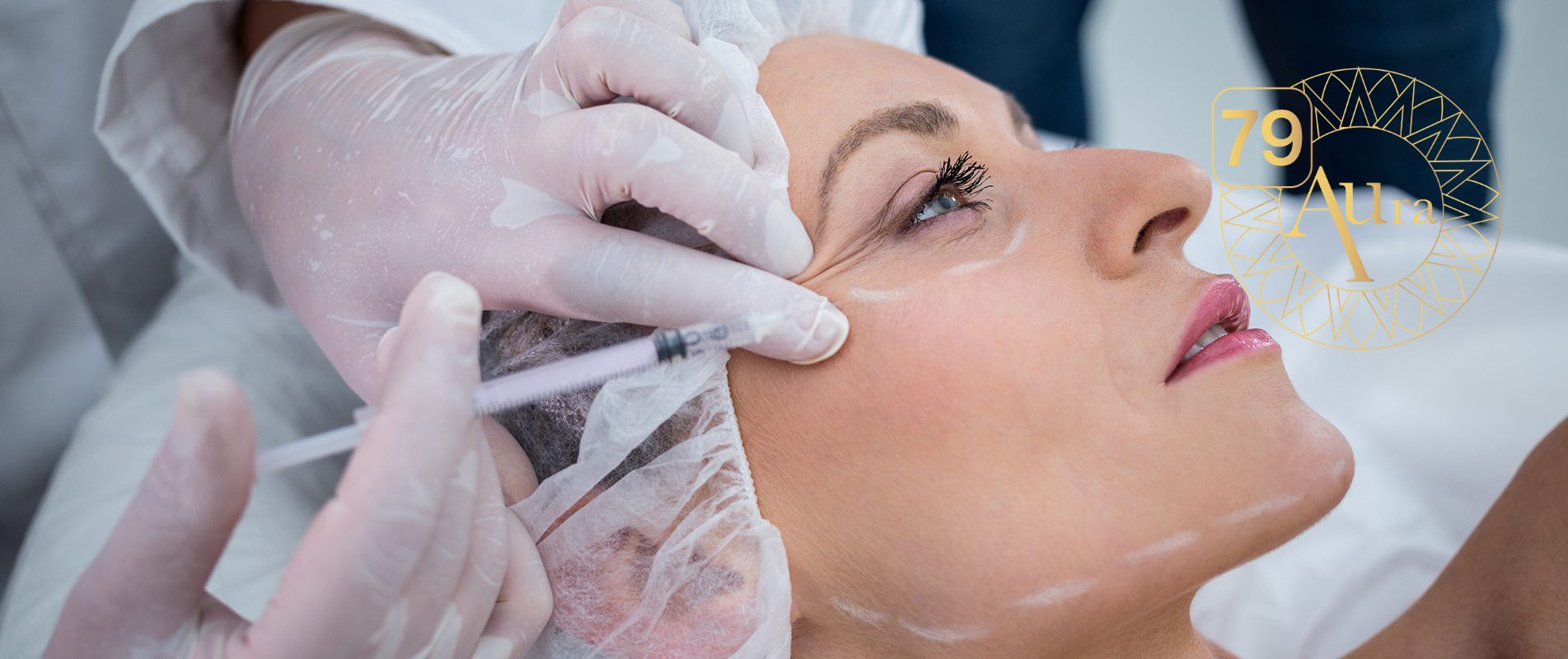
During the appointment, the injection itself takes just a few minutes. Most clients describe the sensation as a small pinch — quick, localized, and very manageable. The number of injection points varies depending on the treatment area and product being used. The entire in-office experience is typically completed in 20 to 30 minutes.
After your appointment, you can return to most normal activities immediately. You’ll be advised to avoid lying flat or applying pressure to the treated area for a few hours, and to skip intense exercise for the remainder of the day. Minor swelling, redness, or pinpoint bruising at injection sites is normal and typically resolves within a day or two.
Results begin to appear within two to five days and are fully settled within one to two weeks. A two-week follow-up is often recommended for new clients to assess the result and address any areas that need minor refinement.
10. How Long Do Results Last?
Both Botox and Dysport are temporary treatments. Results typically last three to four months, though this varies between individuals based on metabolism, the treatment area, dosage, and activity level. Very athletic individuals and those with high metabolic rates may find results fade slightly faster.
With consistent treatment over time, many clients find that their results last longer — likely because the targeted muscles adapt to reduced activity and the skin benefits from extended periods of reduced mechanical stress. Regular maintenance every three to four months is the standard protocol for most clients.
11. The Physician Difference: Why Provider Expertise Matters
We said it earlier and it bears repeating, because it genuinely cannot be overstated: the most important variable in your neurotoxin experience is the expertise of your provider.
Neurotoxin injection is not simply a matter of reading a package insert and following a map. Facial anatomy is complex, individual variation is significant, and the margin between a beautiful result and an overcorrected one is measured in tiny units and millimeters of placement. A provider with deep anatomical knowledge and extensive clinical experience brings something to each appointment that no product can substitute for — judgment.
At 79Aura, all neurotoxin treatments are performed under the direct oversight of Dr. Patricia Gomez Dinger, whose approach combines clinical precision with a genuine aesthetic sensibility. Every injection decision reflects both the science of facial anatomy and an understanding of what you actually want your face to look like.
12. Neurotoxins as Part of a Complete Aesthetic Protocol
Neurotoxin injections are powerful on their own — but they are even more effective when integrated into a broader aesthetic strategy.
Combined with PRX biorevitalization, neurotoxins address both the dynamic movement patterns creating lines (neurotoxin) and the skin quality, texture, and firmness that frame those results (PRX). These treatments are highly complementary.
Combined with RF microneedling, you’re addressing lines and laxity simultaneously — neurotoxin softens the upper face while RF remodels collagen at the deeper dermal level.
Combined with injectable wellness — particularly glutathione, vitamin C, and NAD+ — your skin’s cellular foundation is optimized to support and prolong your surface aesthetic results. When your cells are energized and your antioxidant defenses are robust, your skin responds better to every treatment.
This integrated approach is central to how 79Aura thinks about aesthetic medicine — not individual treatments in isolation, but a coordinated protocol where each element amplifies the others.
13. Myths About Neurotoxin Treatments — Set Straight
Myth: Neurotoxins are dangerous. FDA-approved neurotoxin products used in cosmetic dosing have an extensive safety record spanning decades of clinical use. When administered by a qualified provider, serious adverse events are extremely rare.
Myth: If you stop getting treatments, your face will look worse than before. Your face will simply return to its pre-treatment baseline. Neurotoxins do not accelerate aging or cause structural changes that make you look worse when you stop.
Myth: Neurotoxins are only for women. Men represent a significant and growing percentage of neurotoxin patients. The treatment goals simply reflect different aesthetic standards — men typically prefer a result that looks refreshed and naturally vigorous rather than classically smooth.
Myth: More units means better results. Not at all. The goal is the minimum effective dose that achieves your aesthetic objective. Overcorrection creates the frozen appearance that no one wants. Less, placed well, is almost always better.
Myth: You have to be older to start neurotoxin treatment. As discussed, the preventative application of neurotoxins is increasingly well-supported. The right time to start is determined by your anatomy, your muscle movement patterns, and your goals — not a specific age number.
14. Finding the Right Neurotoxin Provider in San Antonio
San Antonio has no shortage of clinics offering neurotoxin injections — and that abundance of options makes knowing what to look for even more important.
Here is what genuinely matters when evaluating a provider:
Physician oversight. Whether the injector is a physician, nurse practitioner, or PA, physician oversight of the treatment protocol makes a meaningful difference in both safety and outcome quality.
Anatomy-based approach. A quality provider will assess your facial anatomy before recommending anything — not just point to a price list and ask what you want treated.
Honest consultation. The right provider will tell you what will and won’t be achievable with neurotoxin alone — and will refer you toward complementary treatments if your goals would be better served by a different approach.
Before-and-after transparency. Reviewing a provider’s actual patient results (with consent) gives you a real-world sense of their aesthetic sensibility and technical skill.
At 79Aura Aesthetics & Wellness in San Antonio, neurotoxin treatments are performed with physician involvement, an anatomy-first approach, and a genuine commitment to results that look like you — only more rested, more refined, and more radiant.
Conclusion
Choosing between Botox and Dysport is ultimately a smaller decision than most people think — because both products, used correctly by a skilled provider, can deliver beautiful, natural, lasting results. The bigger decisions are choosing the right provider, approaching treatment with realistic expectations, and thinking about neurotoxins not as a one-time fix but as part of an ongoing investment in how you age.
Whether you’re considering your first treatment, switching providers, or just trying to understand your options more clearly, we hope this guide has given you a foundation to walk into your consultation with confidence. Because that’s exactly the kind of client every great provider loves to work with — one who is informed, engaged, and genuinely excited about what thoughtful aesthetic medicine can do for them.
Frequently Asked Questions
1. What is the difference between Botox and Dysport? Both contain botulinum toxin type A and work the same way — by temporarily relaxing targeted facial muscles. They differ in formulation, diffusion behavior, unit dosing, and onset time. Your provider will recommend the right product based on your anatomy and treatment goals.
2. Does getting neurotoxin injections hurt? Most clients describe the sensation as a brief, small pinch at each injection point. The needles used are very fine, and the procedure is well tolerated by the vast majority of patients. Topical numbing is available if desired.
3. How long do Botox and Dysport last? Both typically last three to four months, though individual metabolism, activity level, and treatment area can affect duration. Consistent maintenance treatments often extend the time between appointments over time.
4. What is the right age to start neurotoxin treatment? There is no single right age. Many providers recommend a preventative consultation in the late 20s to early 30s. The right time depends on your muscle movement patterns, facial anatomy, and personal goals — not a number.
5. Can I return to work after neurotoxin injections? Yes. Most clients return to normal activities immediately. You’ll be advised to avoid lying flat or exercising intensely for the remainder of the day, and to skip facials or massage in the treated area for two weeks.
6. Will I look frozen or unnatural? Not with proper dosing and placement. Natural-looking results are entirely achievable — and are the goal at physician-led practices. The “frozen” look is a dosing and placement issue, not an inherent product characteristic.
7. How do I know which areas to treat? Your provider will assess your facial anatomy and muscle movement patterns during your consultation and make specific recommendations based on your concerns and goals. You don’t need to come in with a treatment plan — that’s what the consultation is for.
8. Can men get neurotoxin treatments? Absolutely. Neurotoxin treatment is appropriate for anyone who wants to address dynamic lines and invest in how they age. Treatment goals and dosing are simply calibrated to reflect individual anatomy and aesthetic preferences.
9. Is there anyone who should not get neurotoxin injections? Neurotoxin treatment is not recommended during pregnancy or breastfeeding. Clients with certain neuromuscular conditions should consult with their physician before treatment. A thorough health intake at your consultation will identify any relevant considerations.
10. Where can I get neurotoxin treatments in San Antonio? 79Aura Aesthetics & Wellness, led by Dr. Patricia Gomez Dinger, offers physician-supervised Botox and Dysport in San Antonio, Texas. New client consultations can be scheduled at 79aura.com.
This article is for educational purposes only and does not constitute medical advice. Individual results vary. Consult a qualified healthcare provider before beginning any aesthetic treatment.
Sources referenced: denverplasticsurgery.com/facial-enhancement/neurotoxins-the-difference-between-botox-and-dysport/
© 79Aura Aesthetics & Wellness — San Antonio, TX — 79aura.com